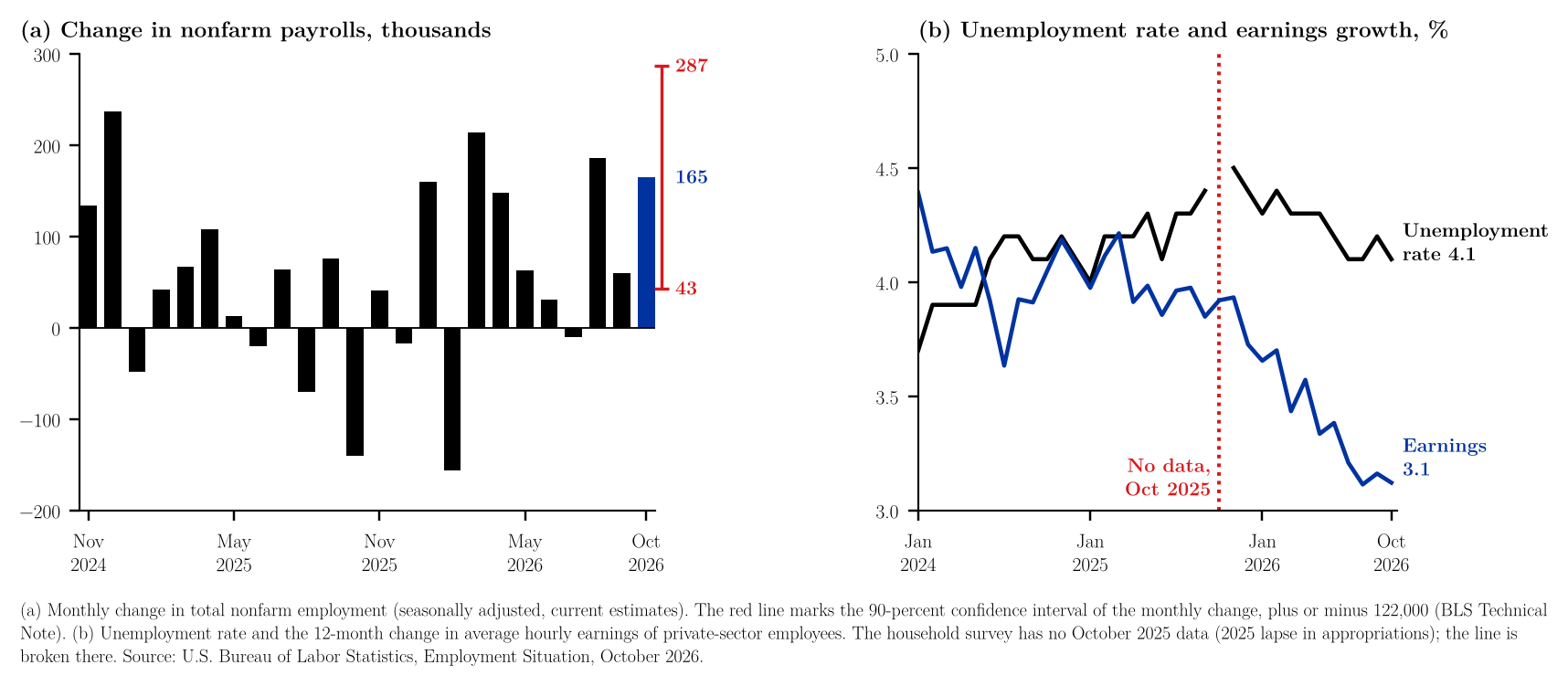
The U.S. Bureau of Labor Statistics (BLS) reported on 6 November that total nonfarm payroll employment rose by 165,000 in October 2026, against an average monthly gain of 48,000 over the prior 12 months (U.S. Bureau of Labor Statistics, 2026a).1 The Technical Note gives the 90-percent confidence interval for the monthly change in total nonfarm employment as "on the order of plus or minus 122,000" (U.S. Bureau of Labor Statistics, 2026b), so the interval for October runs from 43,000 to 287,000, and its lower end is above zero.2 The estimates for August and September were revised up: August from 133,000 to 186,000 and September from 29,000 to 60,000, 84,000 more in total. The average of the three current estimates, August to October, is 137,000 a month.3
By industry, professional and business services added 70,000 jobs (average of the prior 12 months, 15,000), health care 42,000 (31,000), transportation and warehousing 25,000 and manufacturing 19,000. The BLS reports little change in the other major industries.
In the household survey the unemployment rate was 4.1%, against 4.2% in September, and 7.1 million people were unemployed. The rate has stayed between 4.1% and 4.3% since March. The participation rate was 61.9% (61.8% in September) and the employment-population ratio 59.3% (59.2%). The number of people working part time for economic reasons rose by 339,000 to 4.8 million. The Technical Note gives about plus or minus 0.3 percentage point for the 90-percent interval of the monthly change in the unemployment rate; it states this at an unemployment rate of around 6.0%, so it is only a rough guide at 4.1%. The household survey has no figures for October 2025: the BLS did not collect Current Population Survey data that month, because of the lapse in appropriations from 1 October to 12 November 2025, and did not collect them retroactively (U.S. Bureau of Labor Statistics, n.d.; Figure 1b).
Average hourly earnings of private-sector employees rose by 14 cents, or 0.4%, to $38.00 (about 1,906 Turkish liras, at the ECB reference rate of 50.1529 liras per dollar on 6 November; European Central Bank, 2026), and by 3.1% over the 12 months. The average private workweek stayed at 34.4 hours. For comparison, hourly compensation in the nonfarm business sector rose 4.5% on the year in the third quarter (Yılmaz, 2026). The next release, for November, is due on 4 December.
References
European Central Bank. (2026, November 6). Euro foreign exchange reference rates: US dollar and Turkish lira, USD/TRY cross rate (data set). ECB Data Portal. https://data.ecb.europa.eu/
U.S. Bureau of Labor Statistics. (n.d.). 2025 federal government shutdown impact on the Current Population Survey. Retrieved November 7, 2026, from https://www.bls.gov/cps/methods/2025-federal-government-shutdown-impact-cps.htm
U.S. Bureau of Labor Statistics. (2026a, November 6). The Employment Situation – October 2026 (USDL-26-1632). https://www.bls.gov/news.release/archives/empsit_11062026.htm (PDF: https://www.bls.gov/news.release/archives/empsit_11062026.pdf)
U.S. Bureau of Labor Statistics. (2026b). Employment Situation technical note. Retrieved November 7, 2026, from https://www.bls.gov/news.release/empsit.tn.htm
U.S. Bureau of Labor Statistics. (2026c). Current Employment Statistics and Current Population Survey, seasonally adjusted series CES0000000001, CES0500000003, CES0500000002, LNS14000000, LNS11300000, LNS12300000 and LNS13000000 (data set). Downloaded November 7, 2026, from https://data.bls.gov/timeseries/CES0000000001
Yılmaz, M. İ. (2026, November 7). US productivity and costs, third quarter of 2026: productivity up 3.6%, unit labor costs down 0.7%, and a labor share of 53.0%, the lowest since the series began in 1947. https://muhammedikbalyilmaz.com/posts/us-productivity-costs-q3-2026.html
Notes
-
The payroll change, the prior 12-month average, the revisions of August and September (from +133,000 to +186,000 and from +29,000 to +60,000), the industry changes and prior 12-month averages, the household survey figures, part-time work for economic reasons, average hourly earnings, the workweek and the date of the next release are from the BLS release (U.S. Bureau of Labor Statistics, 2026a). The interval figures and the definition of the confidence interval are from the Technical Note (2026b). The absence of October 2025 household data, the dates of the lapse in appropriations and the statement that the data were not collected retroactively are from the BLS page on the shutdown's impact on the Current Population Survey (n.d.). The pages of the release and the Technical Note were read on 7 November 2026. ↑
-
Monthly changes are the differences of the seasonally adjusted payroll levels (series CES0000000001), the unemployment rate is series LNS14000000, the participation rate LNS11300000, the employment-population ratio LNS12300000, the number of unemployed LNS13000000, average hourly earnings of private-sector employees CES0500000003 and their average weekly hours CES0500000002, January 2022 – October 2026, downloaded 7 November 2026 (U.S. Bureau of Labor Statistics, 2026c): data (CSV). The figures are the current estimates, so the changes for August and September are those of the revised release. The workbook lists every number in the note next to the formula that produces it and a check against the text, so that readers who wish to examine the calculations can follow and audit them in a spreadsheet without losing time and without running any code. The code that draws the figure and repeats the same calculations is available on request. ↑
-
Calculations (author's). The monthly change is the difference between consecutive payroll levels. The prior 12-month average is the level of September 2026 less the level of September 2025, divided by 12 (580,000 / 12). The October interval is the change plus and minus 122,000, using the BLS figure for the monthly change in total nonfarm employment as given in the Technical Note; it describes sampling error only: $$165{,}000 \pm 122{,}000 = 43{,}000 \text{ to } 287{,}000$$ Earnings growth is the 12-month percentage change of the level. The lira figure, in liras and rounded to 1,906, is 38.00 dollars at 50.1529 liras per dollar: $$38.00 \times 50.1529 = 1{,}905.8$$ The rate is the USD/TRY cross rate of the ECB euro reference rates of 6 November 2026, the latest rate available when the note was written (European Central Bank, 2026), applied to the October average. It restates the dollar figure at the market exchange rate and says nothing about purchasing power. The comparisons are descriptive. ↑