Maurice Allais was born on 31 May 1911 and won the Nobel Prize in Economic Sciences in 1988. William D. Nordhaus was born on 31 May 1941 and won it in 2018. Peter Howitt was born on 31 May 1946 and won it in 2025. Three laureates, born 35 years apart and honoured 37 years apart, with one birthday. Is that a remarkable coincidence? To answer, it may help to start with a drawer full of socks, a puzzle that can easily be found in most sources on the internet.
Goemans (2013, p. 1) opens his MIT lecture with an old puzzle. A mathematician dresses in the dark so as not to wake anyone, and pulls socks out of a drawer that holds only two colours. How many socks must he take to be sure of a matching pair? Three. With more socks than colours, two of them must end up with the same colour. That is the pigeonhole principle: if $k + 1$ or more objects go into $k$ boxes, some box gets at least two (Rosen, 2019, Theorem 1, p. 420). It is also called the Dirichlet drawer principle, after the nineteenth-century German mathematician who used it often, although Rosen points out that it is older than Dirichlet (p. 421). In the 17th century the French writer Pierre Nicole argued that two people in Paris must have the same number of hairs on their heads, and Rosen turns the argument into an exercise (Rosen, 2019, Exercise 35, p. 427). In Rosen's numbers, Paris had more than 800,000 inhabitants, and no head was thought to have more than 200,000 hairs, so the heads could not all be different. Rosen's exercise does assume that no one in Paris was completely bald. Still, why should it not comfort someone like me, who started going bald young, to think that people like us must have been there in the France of the time?
The principle asks for more objects than boxes, and in return it gives a guarantee. In its generalised form, $N$ objects in $k$ boxes leave some box with at least $\lceil N/k \rceil$ objects, that is, $N/k$ rounded up (Rosen, 2019, Theorem 2, p. 422). The Nobel Prize API lists 101 laureates in economics, from 1969 to 2026, and gives a full date of birth for 95 of them. For the other six it gives only the year (Nobel Prize Outreach, 2026).1 So we have 95 objects. It is worth noting that every date below is a date of birth, not the day of the prize.
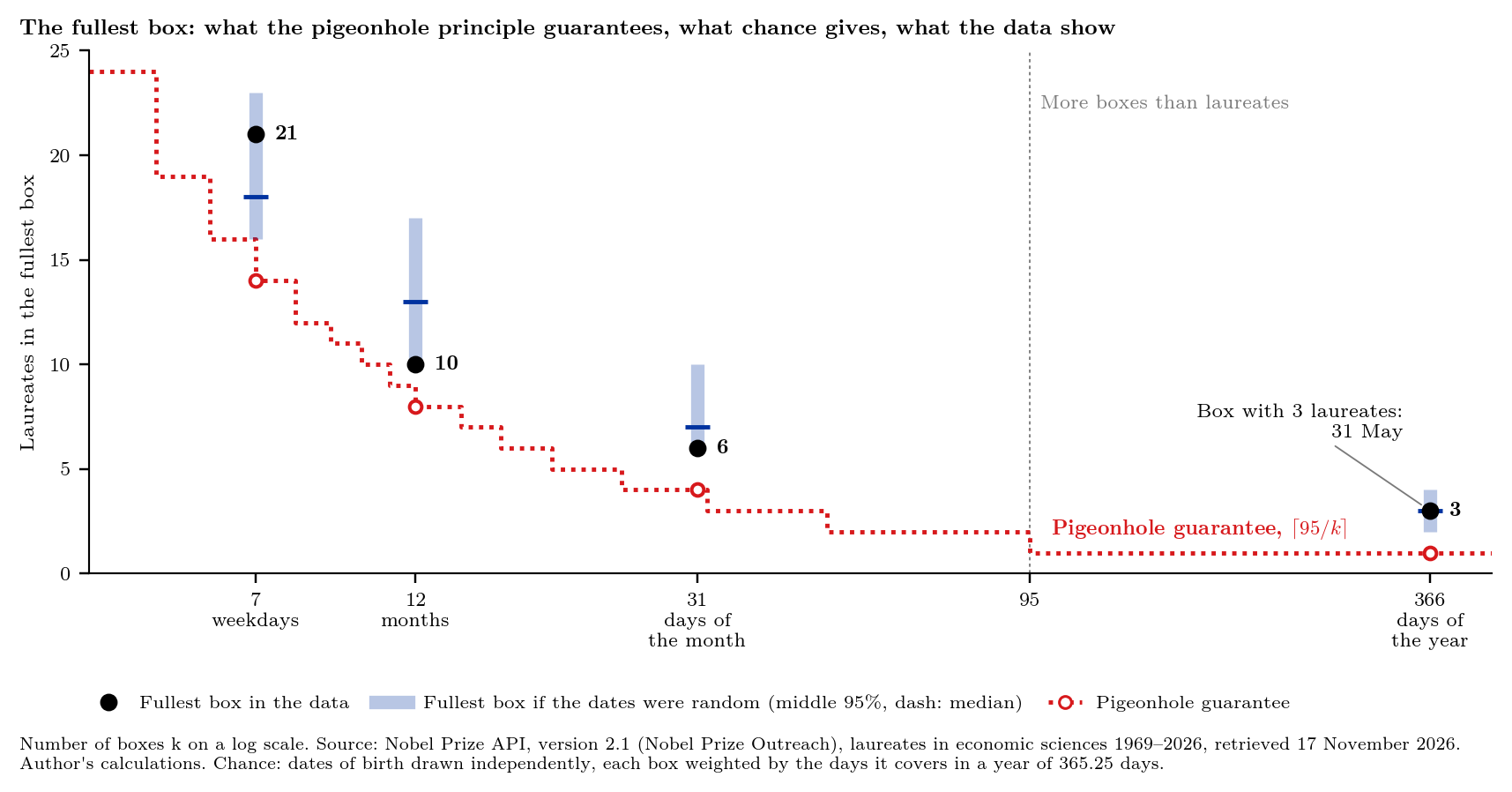
Start with a few large boxes, and with the most striking result. With the seven days of the week as boxes, the principle guarantees that at least $\lceil 95/7 \rceil = 14$ laureates were born on the same weekday. The list has 21 born on a Tuesday alone. The months and the days of the month tell the same story on a smaller scale. With twelve months, at least $\lceil 95/12 \rceil = 8$ must share a month of birth, and April, May, July and August have ten each, while January has only four. With the 31 days of the month, at least $\lceil 95/31 \rceil = 4$ must share a day of the month, and the 5th and the 29th have six each. Not one laureate was born on the 11th of any month. In short, the principle promises 14, 8 and 4, and the fullest boxes hold 21, 10 and 6.
Are these boxes unusually full? Figure 1 adds a benchmark. If the 95 dates of birth were drawn at random, the fullest weekday would hold between 16 and 23 laureates in 95 out of 100 cases, the fullest month between 10 and 17, and the fullest day of the month between 6 and 10. The data sit inside every one of these ranges. If anything, the months are spread too evenly: only about 4 random groups in 100 have a fullest month that holds ten or fewer. With four kinds of boxes checked, one result this far out is not much of a surprise.2
As the number of boxes grows, the guarantee naturally shrinks, from 14 to 8 to 4. With one box for each of the 366 days of the year, it falls to $\lceil 95/366 \rceil = 1$, which is no guarantee at all. Rosen's own example puts the bar for a shared birthday at 367 people (Example 1, p. 421). For three people the bar is higher still. In the form used by Goemans (2013, p. 4), $n$ pigeons in $m$ holes with $n > km$ leave some hole with at least $k + 1$ pigeons. With $k = 2$ and $m = 366$, it takes $2 \times 366 + 1 = 733$ people before three shared birthdays are guaranteed.
This is where the principle falls silent, but the data may not. The laureates have 12 shared birthdays, involving 25 people (Table 1). Simon Kuznets and Theodore W. Schultz were born a year apart, in 1901 and 1902, and both on 30 April. Kenneth J. Arrow and Robert M. Solow share 23 August. And there is the 31 May trio. The list also has its near misses. Howitt and Joel Mokyr were both born in 1946 and both won in 2025, but on different days, 31 May and 26 July. No pair in the table won in the same year.
| Date of birth | Laureates (year of the prize) |
|---|---|
| 5 March | James Tobin (1981), Daniel Kahneman (2002) |
| 29 March | Roger B. Myerson (2007), Robert J. Shiller (2013) |
| 30 April | Simon Kuznets (1971), Theodore W. Schultz (1979) |
| 16 May | Merton H. Miller (1990), Robert B. Wilson (2020) |
| 31 May | Maurice Allais (1988), William D. Nordhaus (2018), Peter Howitt (2025) |
| 1 July | Robert W. Fogel (1993), Myron Scholes (1997) |
| 26 July | Edmund S. Phelps (2006), Joel Mokyr (2025) |
| 31 July | Milton Friedman (1976), Robert C. Merton (1997) |
| 23 August | Kenneth J. Arrow (1972), Robert M. Solow (1987) |
| 3 September | Guido W. Imbens (2021), Daron Acemoglu (2024) |
| 25 October | Esther Duflo (2019), Douglas Diamond (2022) |
| 13 December | Trygve Haavelmo (1989), Ben Bernanke (2022) |
Table 1. Dates of birth shared by two or more of the 95 laureates. Source: Nobel Prize Outreach (2026).
When the principle has nothing left to say in this case, the idea of probability can take over. Rosen (2019, Section 7.2.8, pp. 486–487) calls the birthday problem a famous puzzle whose answer most people find surprisingly small. He assumes that birthdays are independent and that all 366 days are equally likely.3 Each new person who walks into the room must then miss every birthday already there, and the chance that $n$ people all have different birthdays is a product of $n$ fractions that shrinks fast. A shared birthday becomes more likely than not from $n = 23$. For the 95 laureates, the chance that nobody shares a birthday is 1.5 in a million. By the linearity of expectations (Rosen, 2019, Section 7.4.3, p. 506), the expected number of pairs with the same birthday is $\binom{95}{2}/366 = 12.2$. The laureates have 14, counting the 31 May trio as three pairs. In one million simulated groups of 95, the middle 95% had between 6 and 20 pairs.4 The laureates are an ordinary draw.
The trio is no different. Run the same calculation for three people and the threshold is $n = 88$: from 88 people on, three with the same birthday are more likely than not (Figure 2). For a group of 95 the probability is 0.589. Allais, Nordhaus and Howitt are not a quirk of economists. A trio like theirs is what one should expect, a little more often than not.
It is tempting to object that 31 May in particular must be unlikely. It is. The chance that one given day, fixed in advance, collects three or more of the 95 laureates is only about 0.23%, roughly 1 in 430.5 But no one picked 31 May in advance. Each of the 366 days had its own small chance, and the 0.589 is the chance that at least one of them, whichever it may be, collects three. The date becomes special only after we have seen it. Had the trio been born on 2 February or 9 October, the same question would have been asked about that day.
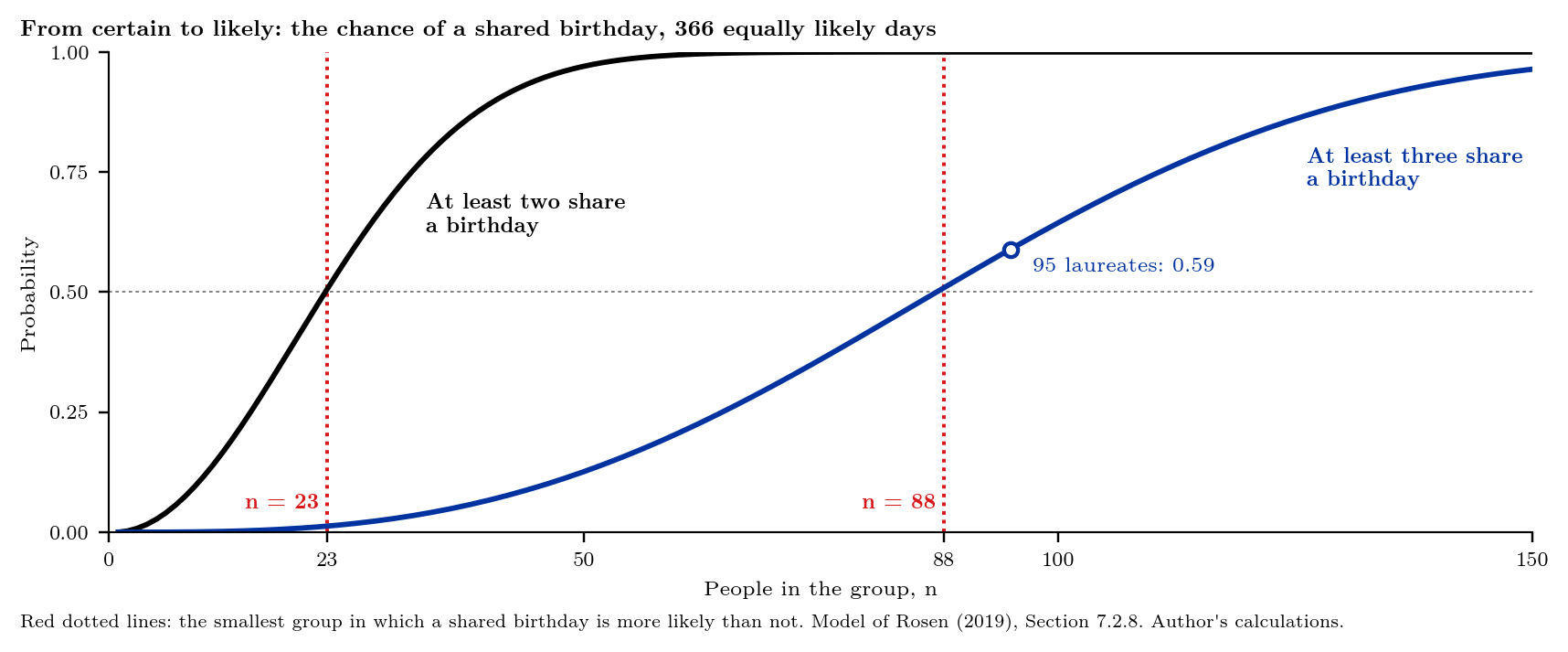
So the story has two halves. In the first, the pigeonhole principle hands out guarantees, 14 for weekdays, 8 for months, 4 for days of the month, and the fullest boxes go beyond each of them with 21, 10 and 6. In the second, the boxes outnumber the people, the guarantees return only at 367 and 733, and probability explains why shared birthdays turn up anyway, from 23 people for a pair and from 88 for a trio. The gap between the two, a factor of about 16 for pairs and 8 for triples, may be thought of as the distance between what must happen and what usually happens. There is a second difference as well. The principle proves that a match exists without saying where it is. Goemans (2013, p. 1) makes the point with sums: among any thirty 7-digit numbers it is easy to prove that two disjoint subsets have the same sum, and much harder to find them. Here the data do the finding, and the match turns out to be Allais, Nordhaus and Howitt.
The model is, of course, a simplification. Rosen (2019, p. 487) notes that more people are born on some days than on others, for example nine months after holidays such as New Year's Eve. For this exercise, the six laureates with only a year of birth are also left out.
So what did the laureates show us? Sorted into a handful of boxes, they filled them just as the pigeonhole principle promised, and then some. Sorted into the 366 days of the year, they slipped out of its reach, yet still produced twelve shared birthdays and one trio, about as many as chance would predict. The 31 May trio is therefore less a secret of economics than a small illustration of how counting works: some things are certain only in large crowds, while others are likely in surprisingly small ones.
References
Goemans, M. (2013). Pigeonhole principle (Lecture notes, 18.310 Principles of Discrete Applied Mathematics, Fall 2013). Massachusetts Institute of Technology, MIT OpenCourseWare. https://ocw.mit.edu/courses/18-310-principles-of-discrete-applied-mathematics-fall-2013/resources/mit18_310f13_ch2/
Nobel Prize Outreach. (2026). Nobel Prize API (Version 2.1): Laureates (data set). https://api.nobelprize.org/2.1/laureates?nobelPrizeCategory=eco&limit=200
Rosen, K. H. (2019). Discrete mathematics and its applications (8th ed.). McGraw-Hill Education.
Notes
-
Data: Nobel Prize API, version 2.1, laureates of the Sveriges Riksbank Prize in Economic Sciences in Memory of Alfred Nobel, retrieved 17 November 2026. The API data are released under the CC0 licence. The list of 101 laureates with their dates of birth and prize years: laureates (CSV). The six laureates whose date of birth is given only as a year are David Card, James A. Robinson, Michael Woodford, Paul M. Romer, Robert E. Hall and Simon Johnson. No laureate was born on 29 February. Days of the week are computed from these dates in the Gregorian calendar. The API does not say which calendar its dates follow, so a laureate born where the Julian calendar was still in use may have a date in the old style. The dates are used as given. The figures and the numbers in this note are produced by
writing/figures/pigeonhole_birthdays.py. ↑ -
Chance benchmark (author's calculations). 400,000 groups of 95 dates of birth drawn independently, with each box weighted by the number of days it covers in a year of 365.25 days (29 February counts one quarter, as in the second alternative of footnote 3). The fullest box, median and 2.5th to 97.5th percentiles: weekday 18 (16 to 23), month 13 (10 to 17), day of the month 7 (6 to 10), day of the year 3 (2 to 4). Share of random groups whose fullest box holds no more than the fullest box in the data: weekday 0.905, month 0.039, day of the month 0.277, day of the year 0.948. NumPy, seed 20261117. ↑
-
Sensitivity (author's calculations). Rosen's 366 equally likely days give 29 February the same weight as any other day, although it comes round about once in four years. The results hardly depend on this choice. With 365 equally likely days, and with 366 days in which 29 February has a quarter of the weight of the others, a shared birthday is again more likely than not from $n = 23$, and three people with the same birthday from $n = 88$. For 95 people the probability of a triple is 0.591 and 0.590 respectively, against 0.589 with 366 equal days, and the expected number of pairs with 365 days is $4465/365 = 12.23$. With unequal day probabilities $p_d$, the probability that no day has three or more people is $n!$ times the coefficient of $x^n$ in $$\prod_{d} \left(1 + p_d x + \frac{p_d^2 x^2}{2}\right)$$ and the probability that all birthdays differ is $n!$ times the coefficient of $x^n$ in $\prod_d (1 + p_d x)$. ↑
-
Calculations (author's). Pigeonhole guarantees for 95 people: $\lceil 95/7 \rceil = 14$, $\lceil 95/12 \rceil = 8$, $\lceil 95/31 \rceil = 4$ and $\lceil 95/366 \rceil = 1$. With 366 equally likely days and $n$ people, the probability that all birthdays differ (Rosen, 2019, p. 487): $$p_n = \frac{365}{366} \cdot \frac{364}{366} \cdots \frac{367 - n}{366}$$ For $n = 23$, $1 - p_{23} = 0.506$. For $n = 95$, $p_{95} = 1.50 \times 10^{-6}$. Each of the $\binom{n}{2}$ pairs shares a birthday with probability $1/366$, so the expected number of such pairs is $$\binom{95}{2} \frac{1}{366} = \frac{4465}{366} = 12.20$$ The expected number of triples is $\binom{95}{3}/366^2 = 1.03$. No day has three or more people when $k$ days have two people and $n - 2k$ days have one. Counting these assignments: $$P(\text{no triple}) = \frac{1}{366^{n}} \sum_{k} \binom{366}{k} \binom{366 - k}{n - 2k} \frac{n!}{2^{k}}$$ This gives $1 - P(\text{no triple}) = 0.498$ for $n = 87$, $0.509$ for $n = 88$ and $0.589$ for $n = 95$. Simulation: one million groups of 95 birthdays drawn independently and uniformly from 366 days (NumPy, seed 20261117). Mean number of pairs 12.20, 2.5th and 97.5th percentiles 6 and 20, share of groups with 14 or more pairs 0.33. ↑
-
A given day (author's calculation). With 366 equally likely days, the number of the 95 laureates born on one day fixed in advance is binomial with $n = 95$ and $p = 1/366$, so $$P(X \geq 3) = 1 - \sum_{j=0}^{2} \binom{95}{j} \left(\frac{1}{366}\right)^{j} \left(\frac{365}{366}\right)^{95 - j} = 0.00234$$ ↑