On 15 October 2026, Tesla unveiled the second-generation Roadster in a livestream from a SpaceX test facility near Waco, Texas. The car was first announced in November 2017, almost nine years earlier.1 In the demonstration, the car drove onto a ramp that curled over and turned it upside down, left the ramp, rotated in mid-air and landed on its wheels. After the event Elon Musk posted a video on X with the line "Turns out the future does have flying cars".2 According to Electrek and Inc., no person was inside the car during the demonstrations; Inc. adds that a mannequin sat in the seat.3 Inc. reported that Musk described the demonstration as "technically autonomous"; Tesla's website, however, gives no technical detail on how the car was controlled, and the duration and height of the flight were not disclosed.
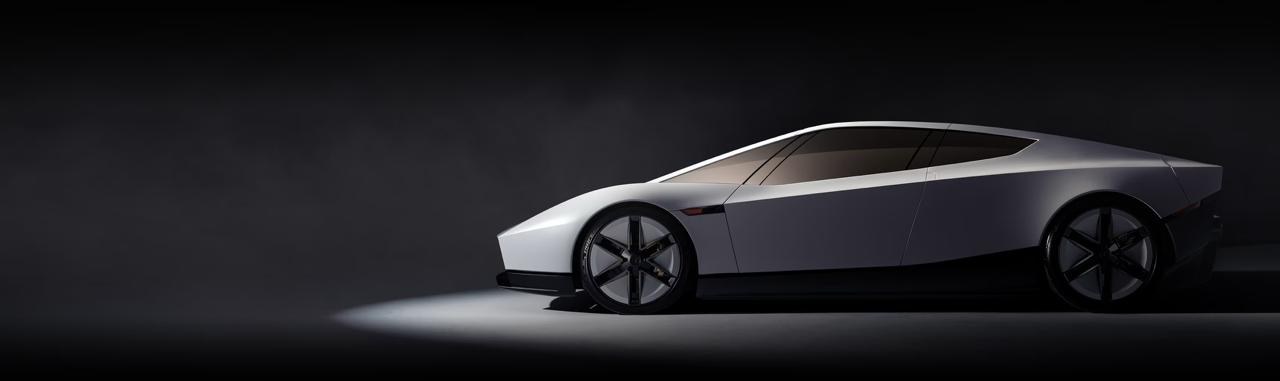
The use Tesla has designed for, however, is a car with a person inside. The company's website presents the Roadster as "a true pilot's car" and mentions manual controls and a fixed seat position as ways of reducing weight.4 Of the three versions, Performance seats two and is sold by reservation. Thrust, offered as a limited release, uses its rear thruster system to go from 0 to 60 mph in under one second; Tesla's official X account put the time in the demonstration at 0.81 seconds, and 0.67 seconds with the rollout subtracted.5 The flying Rocket seats one, is available by invitation only and, in the website's words, is "not approved for public road use". In the United States a reservation costs $50,000 in total: $5,000 due immediately and $45,000 within 10 days, both marked as refundable on the reservation page.6 No sale price was announced. At the event Musk said production would start in 2028 and that success was not guaranteed.1
Despite the name of the Rocket version, the system that produced the clouds of gas in the demonstration resembles a compressed-air tank more than a rocket engine. Tesla's website describes the thrusters as "cold-gas thrusters".4 According to Lars Moravy, Tesla's vice president of vehicle engineering, the thrusters are fed from tanks with a combined capacity of 600 litres, filled with compressed air, and the tanks can be refilled.7 Tesla says the air is held in carbon-fibre overwrapped pressure vessels, a type of tank also used in SpaceX rockets.7 No fuel is burned in the thrusters; what leaves the nozzles is high-pressure air.8 The visible cloud therefore carries no combustion exhaust. This is also where the system's real limit lies: the amount of air the tanks can hold limits how long the thrusters can keep working, and Tesla has not disclosed the tank pressure or the time aloft.
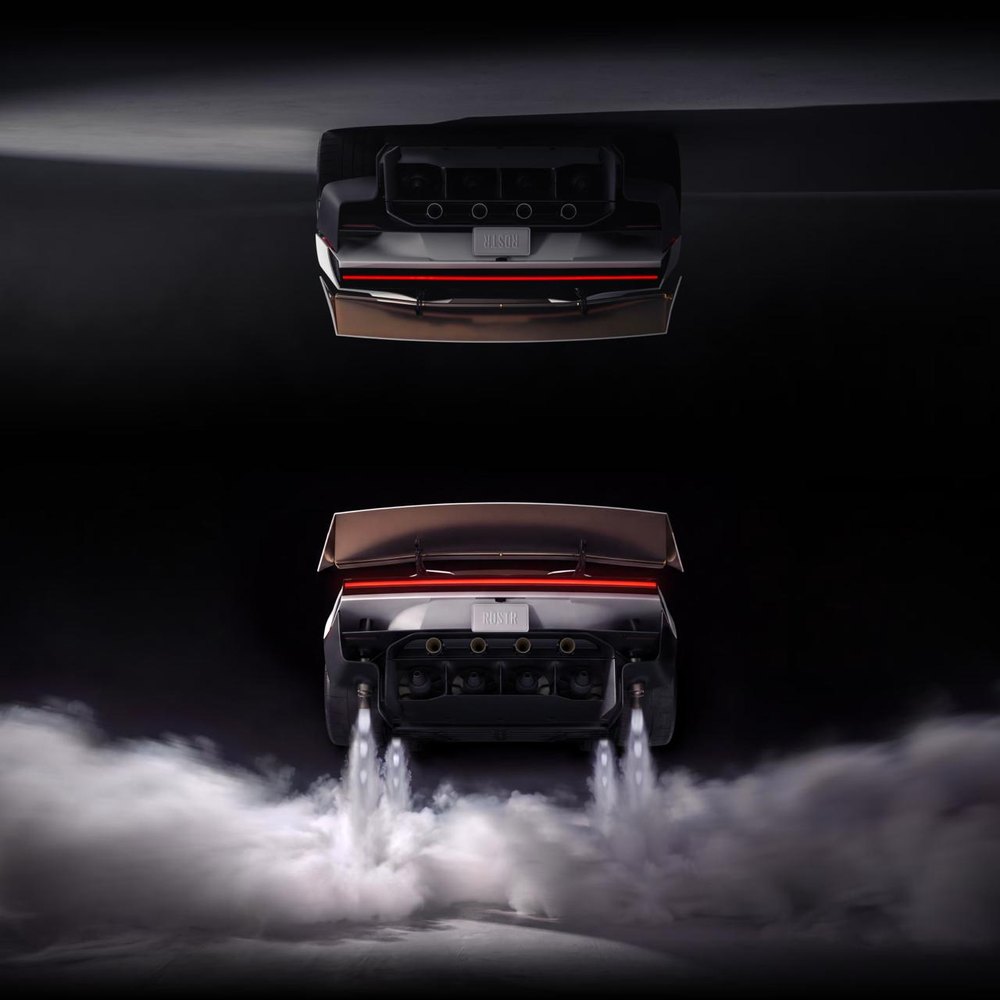
The second part that makes the Roadster interesting is how it holds onto the ground. According to Tesla, fans under the car and a system that seals it against the road pull air from beneath the vehicle and create suction strong enough to hold it upside down even when stationary. According to the same page, the thrusters use all-electric actuators that make small adjustments within a fraction of a second to help stabilise the car in flight.4 How these adjustments are decided, and whether artificial intelligence plays a role, the website does not say. Even so, a car whose balance in the air depends on corrections made within a fraction of a second points to a broader trend in today's technology: computation leaving the screen and starting to act on the physical world.
In recent years artificial intelligence has mostly been known as a tool behind a screen that produces text and images. The trend known as physical AI describes the embedding of this capability directly in household objects, vehicles, robots and operating systems. The difficulty is that the consequence of an error no longer stays on the screen; it appears in the physical world.
Because errors no longer stay on the screen, oversight becomes a question of its own. In an article published in Project Syndicate on 15 October, Angela Huyue Zhang and Yue Zhao argue for independent scrutiny both of what AI systems are capable of and of what their developers are doing to minimise harm and communicate honestly with the public; in their view, although AI auditing is still at an early stage, other industries have already provided a playbook.9 For systems that operate in the physical world this need is even clearer, because the cost of a wrong decision goes beyond a textual error.
This wave also comes with a bill. In an article published in CounterPunch on 16 October, the economist Dean Baker notes that Amazon, Alphabet, Meta, Microsoft and Oracle have committed hundreds of billions of dollars to data centres for AI, and points to an agency problem: even if executives came to believe that the investment will not pay off, they might keep spending, because admitting the mistake would cost them their careers.10 In an article published in Project Syndicate on the same day, Ian Goldin describes a broader risk: if AI concentrates wealth and opportunities in a few cities while destroying the low-cost jobs that have historically fuelled global development, it could slow growth instead of accelerating it and leave much of the world poorer and more divided.11 Both arguments show how large an economic assumption underlies the infrastructure behind AI's move into the physical world.
The technical side of this assumption lies in how today's large language models are trained. They are built on the Transformer architecture proposed by Vaswani and colleagues in 2017.12 At its core, the attention mechanism computes how each element of a sequence relates to the others by weighting them:
$$A=\text{softmax}\!\left(\frac{QK^{\top}}{\sqrt{d_k}}\right)V$$
Here $A$ is the output of the attention layer; $Q$, $K$ and $V$ are the query, key and value matrices obtained from the input by linear transformations, and $d_k$ is the dimension of the key vectors. The model is trained to predict the next piece of text (token): the cross-entropy loss between the predicted probability distribution and the actual token is minimised using gradients computed by backpropagation. In 2020 Kaplan and colleagues showed that this loss falls as a power law as the number of parameters, the amount of data and the compute increase; the compute cost of training is approximately summarised as $C \approx 6ND$ floating-point operations, where $N$ is the number of parameters and $D$ the number of training tokens.13 The 2022 study by Hoffmann and colleagues found that, for a given compute budget, the number of parameters and the amount of data should be scaled together and in roughly equal proportion; the 70-billion-parameter Chinchilla model was trained on 1.4 trillion tokens, about 20 tokens per parameter.14 The fact that better models require more compute is the technical background to the data-centre race Baker describes.
Things work differently in the physical world, because the aim there is to choose the right action rather than produce the right text. Such problems are often approached with reinforcement learning: at each step an agent chooses an action and tries to maximise the expected value of the discounted sum of future rewards, $\mathbb{E}\left[\sum_{t} \gamma^{t} r_t\right]$, where $0 \le \gamma < 1$ is the discount factor. PPO (Proximal Policy Optimization), proposed by Schulman and colleagues in 2017, is one of the most widely used methods in this field.15 Because robots cannot be tried millions of times in the real world, training is often done in simulation; to close the gap between simulation and reality, techniques such as domain randomisation, proposed by Tobin and colleagues in 2017, deliberately vary the physical and visual conditions in the simulation.16 For tasks such as keeping a flying vehicle stable, methods from classical control theory are also widely used; model predictive control, for example, uses a model of the system at each step to compute the best sequence of actions over a finite horizon, applies only the first action, and repeats the calculation at the next step.17 Tesla's website gives no information on which of these methods, if any, the Roadster's control system uses.
Econometrics has a concept close to this problem: external validity, the question of whether a result obtained in one sample carries over to another setting. In machine learning the analogous problem is known as distribution shift: a model trained on one data distribution has no guarantee of keeping its in-sample performance when used on a different one. Moving from simulation to the real road, or from a test track to city traffic, is this kind of shift. This uncertainty is why independent testing, of the kind Zhang and Zhao call for, matters for systems that act in the physical world: we cannot yet know with certainty how these models will behave outside the environment they were trained in.
For now, the Roadster is only a waypoint on a timeline that runs from a promise made in 2017 to production planned to start in 2028. What was shown on 15 October was a controlled jump and rotation with nobody on board. The flying version is not approved for public roads, so the next test is twofold: flying with a pilot on board, and obtaining the regulatory approval that would let such a car leave the test site. Keeping these two stages apart is the first step towards reading correctly how close both the flying car and physical AI really are.
Notes
-
Tesla, X (@Tesla), "Roadster event livestream", 15 October 2026, https://x.com/Tesla/status/2110788059008819215; and the reports CBS News, "With Tesla Roadster debut, Elon Musk shows 'flying cars are real'", 16 October 2026, https://www.cbsnews.com/news/tesla-roadster-debut-elon-musk-flying-cars-are-real/; Forbes, "Tesla Unveiled A Car Elon Musk Says Can Fly—What We Know", 16 October 2026, https://www.forbes.com/sites/fionariley/2026/10/16/tesla-unveiled-a-car-elon-musk-says-can-fly-what-we-know/; TechCrunch, "Tesla reveals SpaceX-powered Roadster that flies and falls with style", 15 October 2026, https://techcrunch.com/2026/10/15/tesla-reveals-spacex-powered-roadster-that-flies-and-falls-with-style/. The ramp demonstration, the 2028 production plan and Musk's remark that success is not guaranteed are reported by CBS News and Forbes; the November 2017 announcement by Forbes. TechCrunch places the event outside Waco, Texas, while CBS News and Forbes describe it as a SpaceX test facility in Texas. ↑↑
-
Elon Musk, X (@elonmusk), 16 October 2026, 01:57 UTC, https://x.com/elonmusk/status/2110913107094606330. ↑
-
Electrek, "Are Tesla's claims for its new 'flying' Roadster real, or is it just full of cold gas?", 15 October 2026, https://electrek.co/2026/10/15/an-updated-technical-look-at-teslas-kick-flipping-0-60-in-1s-next-gen-roadster/; Inc., "Elon Musk Just Pulled off a Magic Trick With the New Tesla Roadster", 16 October 2026, https://www.inc.com/connor-jewiss/with-the-new-tesla-roadster-elon-musk-just-pulled-off-a-magic-trick/91421177. ↑
-
Tesla, Roadster page, https://www.tesla.com/roadster, accessed 9 November 2026. Figures 1 and 2 are images from this page (files Roadster-02-Pilot and Roadster-06-Gravity), © Tesla. ↑↑↑
-
Tesla, X (@Tesla), "0-60 mph in 0.81 seconds", 16 October 2026, https://x.com/Tesla/status/2110963770763649487; the 0.67-second figure is Tesla's reply to the same post. ↑
-
Tesla, Roadster reservation page (US), https://www.tesla.com/roadster/reserve, accessed 9 November 2026. ↑
-
Moravy's statements during the livestream as reported in TechCrunch, "Tesla reveals SpaceX-powered Roadster that flies and falls with style", 15 October 2026, https://techcrunch.com/2026/10/15/tesla-reveals-spacex-powered-roadster-that-flies-and-falls-with-style/, and EVXL, "Tesla Roadster Thrusters Up Close: A Tank of Air and Four Nozzles", 16 October 2026, https://evxl.co/2026/10/16/tesla-roadster-thrusters-compressed-air-tank/; the carbon-fibre overwrapped pressure vessels are also mentioned in Forbes, "Tesla Unveiled A Car Elon Musk Says Can Fly—What We Know", 16 October 2026, https://www.forbes.com/sites/fionariley/2026/10/16/tesla-unveiled-a-car-elon-musk-says-can-fly-what-we-know/. ↑↑
-
Yahoo Autos, "Yes, the Tesla Roadster Flew. Here's How the Rocket Powered Car Works", 16 October 2026, https://autos.yahoo.com/ev-and-future-tech/articles/did-tesla-roadster-fly-heres-022207241.html; Inc., "Elon Musk Just Pulled off a Magic Trick With the New Tesla Roadster", 16 October 2026, https://www.inc.com/connor-jewiss/with-the-new-tesla-roadster-elon-musk-just-pulled-off-a-magic-trick/91421177; EVXL, "Tesla Roadster Thrusters Up Close: A Tank of Air and Four Nozzles", 16 October 2026, https://evxl.co/2026/10/16/tesla-roadster-thrusters-compressed-air-tank/. ↑
-
Angela Huyue Zhang and Yue Zhao, "Independent AI Auditing Now", Project Syndicate, 15 October 2026, https://www.project-syndicate.org/commentary/independent-ai-auditing-possible-and-necessary-by-angela-huyue-zhang-and-yue-zhao-2026-10. ↑
-
Dean Baker, "What Does AI Say About the Hyperscalers' Decision to Keep Building Data Centers?", CounterPunch, 16 October 2026, https://www.counterpunch.org/2026/10/16/what-does-ai-say-about-the-hyperscalers-decision-to-keep-building-data-centers/. ↑
-
Ian Goldin, "From AI Boom to Economic Bust", Project Syndicate, 16 October 2026, https://www.project-syndicate.org/onpoint/ai-revolution-could-leave-everyone-worse-off-by-ian-goldin-2026-10. ↑
-
A. Vaswani et al., "Attention Is All You Need", Advances in Neural Information Processing Systems 30 (2017), https://arxiv.org/abs/1706.03762. ↑
-
J. Kaplan et al., "Scaling Laws for Neural Language Models" (2020), https://arxiv.org/abs/2001.08361. The paper states training compute as $C \approx 6N$ floating-point operations per training token (non-embedding parameters $N$), and as $C \approx 6NBS$ in total, with $B$ the batch size and $S$ the number of steps; the form $6ND$ is used in the Hoffmann et al. paper cited next. ↑
-
J. Hoffmann et al., "Training Compute-Optimal Large Language Models" (2022), https://arxiv.org/abs/2203.15556. ↑
-
J. Schulman et al., "Proximal Policy Optimization Algorithms" (2017), https://arxiv.org/abs/1707.06347. ↑
-
J. Tobin et al., "Domain Randomization for Transferring Deep Neural Networks from Simulation to the Real World", IEEE/RSJ IROS (2017), https://arxiv.org/abs/1703.06907. ↑
-
J. B. Rawlings, D. Q. Mayne and M. M. Diehl, Model Predictive Control: Theory, Computation, and Design, 2nd ed., Nob Hill Publishing (2017), https://sites.engineering.ucsb.edu/~jbraw/mpc/. ↑